
US Market Intelligence Brief
Report as-of (US/Eastern): 2026-09-24 09:31:47 EDT
Executive summary
As-of: 2026-09-24 09:31:47 EDT (opening prints — <2 minutes into the session; expect wide spreads and revision).
- The AI-datacenter complex is today's volatility epicenter. Reports that Oracle triggered force majeure on its massive "Project Jupiter" data-center build (Seeking Alpha, today 9:12 AM ET) hit the theme at the open: ORCL −4.0%, BE −6.9% (Bloom is implicated via the Oracle project), U −2.0% in sympathy.
- MCD +0.8% is the only green snapshot name — a defensive bid inside a still-negative weekly/monthly trend.
- Trending list is a quality/junk mix: actionable large/mega-caps (ORCL, BE, MCD, U) plus unvetted low-caps (GCTK, PFSA, WETO, SRZN) that are excluded per mandate (no data, hype-driven).
- Posture: this is an event-driven thematic repricing, not a broad macro shock. Defined-risk bearish structures are primary across all four actionable names; keep size small until Project Jupiter facts are confirmed.
Market regime check (S&P 500 + sector/thematic ETFs)
- Data gap flagged: no index/ETF snapshot (SPY/QQQ/IWM) and no Taiwan, memory/semiconductor, oil, or gold ETF quotes were captured this session. Regime read is qualitative, not quote-verified.
- Last confirmed broad-tape color (Yahoo live blog, Sep 22 — dated): Dow/S&P/Nasdaq drifted higher as oil prices retreated. Treat as stale context only.
- Today's stress is thematic, not systemic: a single-name capex/credit event (ORCL force majeure) propagating through the AI-power supply chain. Key tell for regime shift: whether selling spills into the wider semis/power complex and drags the index ETFs, or stays contained to the hype names.
Why these names are trending (search momentum + price action)
| Ticker | Last | Day | 1w | 1m | Driver |
|—|—|—|—|—|—|
| BE | $256.00 | −6.92% | −8.94% | +17.58% | Oracle Project Jupiter force majeure; crowded AI-power long (+218% YTD, fresh S&P 500 member) unwinding |
| ORCL | $138.70 | −4.04% | −7.84% | −4.13% | Force majeure + AI-capex/debt scrutiny + 2,500+ layoffs vs $664B backlog bulls |
| U | $43.25 | −1.95% | +2.80% | −6.17% | High-beta AI/gaming sentiment; weekly bounce stalling at ~44 |
| MCD | $240.26 | +0.80% | −3.30% | −9.74% | ArchIQ AI-OS skepticism; defensive rotation bid |
- No-data trending tickers: BB, FSLY (mid-cap software — monitor only, no quotes/news in capture); GCTK, PFSA, WETO, SRZN (low-cap momentum bait — avoid).
Key news drivers
- Oracle triggers force majeure on "Project Jupiter" (investing.com) — the session's defining headline; force majeure on a flagship AI build raises timeline/capex-credit questions for the entire AI-infrastructure chain.
- "Bloom Energy slides on reported Oracle data center force majeure" (Seeking Alpha, Sep 24, 9:12 AM ET) — this is a confirmed BE-specific catalyst, overriding the pre-open options note's "contaminated feed / no BE catalyst" caveat. The −7% open is event-driven, not mere profit-taking.
- ORCL counter-flow: $664B backlog, 121% OCI growth, 69.5% total return, "27% undervalued" thesis, $0.50 dividend (ex-date Oct 9, 2026) — vs "Reality Check Incoming," AI-debt worries, layoffs. Genuinely two-sided tape.
- BE extension risk: close 255.85 vs 2-yr average close ~104.24 — the stock trades ~2.5x its historical mean; crowded longs amplify downside air pockets.
- MCD: ArchIQ (AI restaurant OS) unveiling was sold ~4% Wednesday — AI-capex skepticism is spreading beyond tech.
- Curated headline feed (WIRED tech-culture items) contains zero market signal — disregard.
Durable momentum ideas (mid/high-cap focus)
Honest read: no clean long-momentum entry today — the strongest trend is sitting on the catalyst.
- BE — watchlist, not entry. The 1m +17.6% uptrend is real (AI-power demand + index-inclusion flows), but today's headline strikes directly at the revenue thesis. Durability now hinges on the *scope* of the force majeure. Re-entry only after clarification and a reclaim of prior close (~275).
- ORCL — structural bull, tactically broken. Backlog + OCI growth is genuine multi-quarter momentum; price is ~24% below its 2-yr average close (~183.60) and ~57% off the 324.63 high close. Best 6–12m durability argument of the four, but do not catch the falling knife — wait for the weekly trend to stabilize.
- MCD — defensive rotation, not momentum. Only green name; 1m −9.7% disqualifies it as momentum, but it is the natural hideout if AI-capex de-rating broadens.
- Explicitly excluded: GCTK, PFSA, WETO, SRZN — low-cap, unverified, no data support.
Options / structure ideas
*Educational options-structure commentary only — not financial advice. All expiries 2026-10-02 (~8 DTE). Chain captures are stale (Sep 23 prints), bid/ask 0.00/0.00, IV fields corrupt — re-price everything live, limit orders at midpoint only, stand aside the first 5–10 minutes.*
- BE — Primary: PUT. 255/240 put debit spread (255P stale ref 5.20; put volume 135 vs call 1 confirms bearish flow). *Call side (lower conviction):* 260/270 call debit spread only on VWAP/prior-close reclaim, or 270C covered call for existing longs. Force-majeure clarification can gap either way.
- ORCL — Primary: PUT. 139/134 put debit spread. *Call side (lower conviction):* 139/144 call spread as small bounce lotto; covered call for holders. Ex-div Oct 9 is post-expiry but matters if rolling.
- MCD — Primary: PUT. 240/235 put debit spread, target net debit ≤ ~2.20; enter into pre-market strength toward 242+. *Call side:* 245C covered call for holders; skip pure upside.
- U — Primary: PUT. 43/41 put debit spread (est. debit ~0.80–1.20 off stale marks). *Call side (lower conviction):* 43.5/46 call spread only if 44.10 reclaimed and held; 45C covered call for holders. Thin OI — expect wide markets.
Risks & watch-outs
- Headline risk, both directions: force majeure scope is unconfirmed — denial/clarification could trigger a violent reversal in BE/ORCL; escalation could spread to semis and the power complex.
- Mean-reversion risk: BE (+17.6% 1m) and ORCL (−7.8% 1w) are both stretched; snapbacks are the main way the primary put structures lose.
- Data integrity: stale chains, zeroed bid/ask, corrupt IV, missing index/ETF snapshot, no fresh U/MCD-specific headlines, non-financial curated feed.
- Microstructure: 8-DTE theta and pin risk near strikes; wide opening-minute markets; ORCL ex-dividend (Oct 9) relevant if rolling.
- Theme fragility: AI-capex skepticism (ORCL debt pieces, layoffs, MCD ArchIQ reaction) is broadening — a theme-level de-rating is the tail risk to every long-momentum thesis above.
Visual strategy maps
Payoff curves and entry/exit zones below are educational aids — not trade instructions. Confirm with your own chart, liquidity, and risk limits.
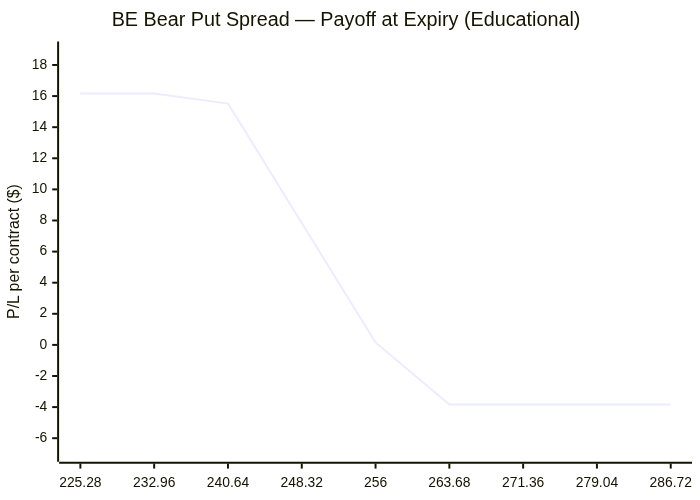
BE: Bear Put Spread
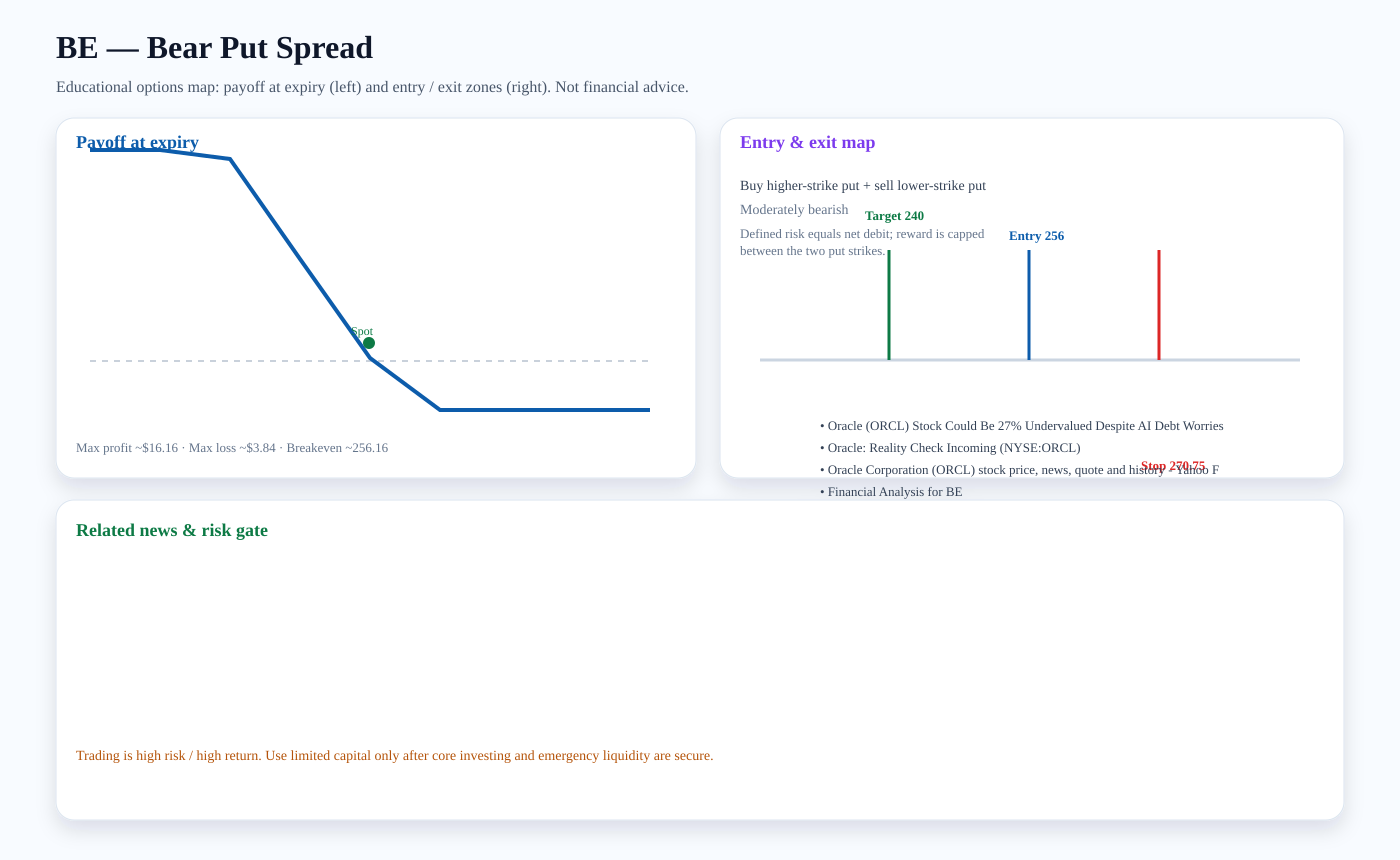
Structure: Buy higher-strike put + sell lower-strike put
Outlook: Moderately bearish
Entry zone: ~256 · Target: ~240 · Stop: ~270.75 · Breakeven: ~256.16
Risk note: Defined risk equals net debit; reward is capped between the two put strikes.
Related news links:
Payoff chart (Mermaid):
Entry / exit map (Mermaid):

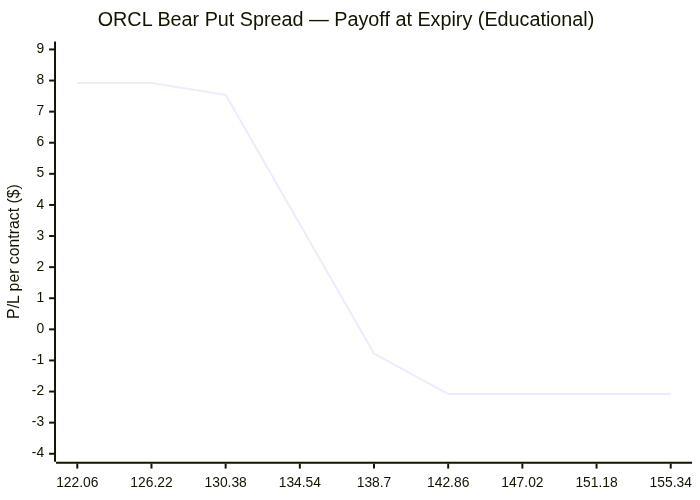
ORCL: Bear Put Spread
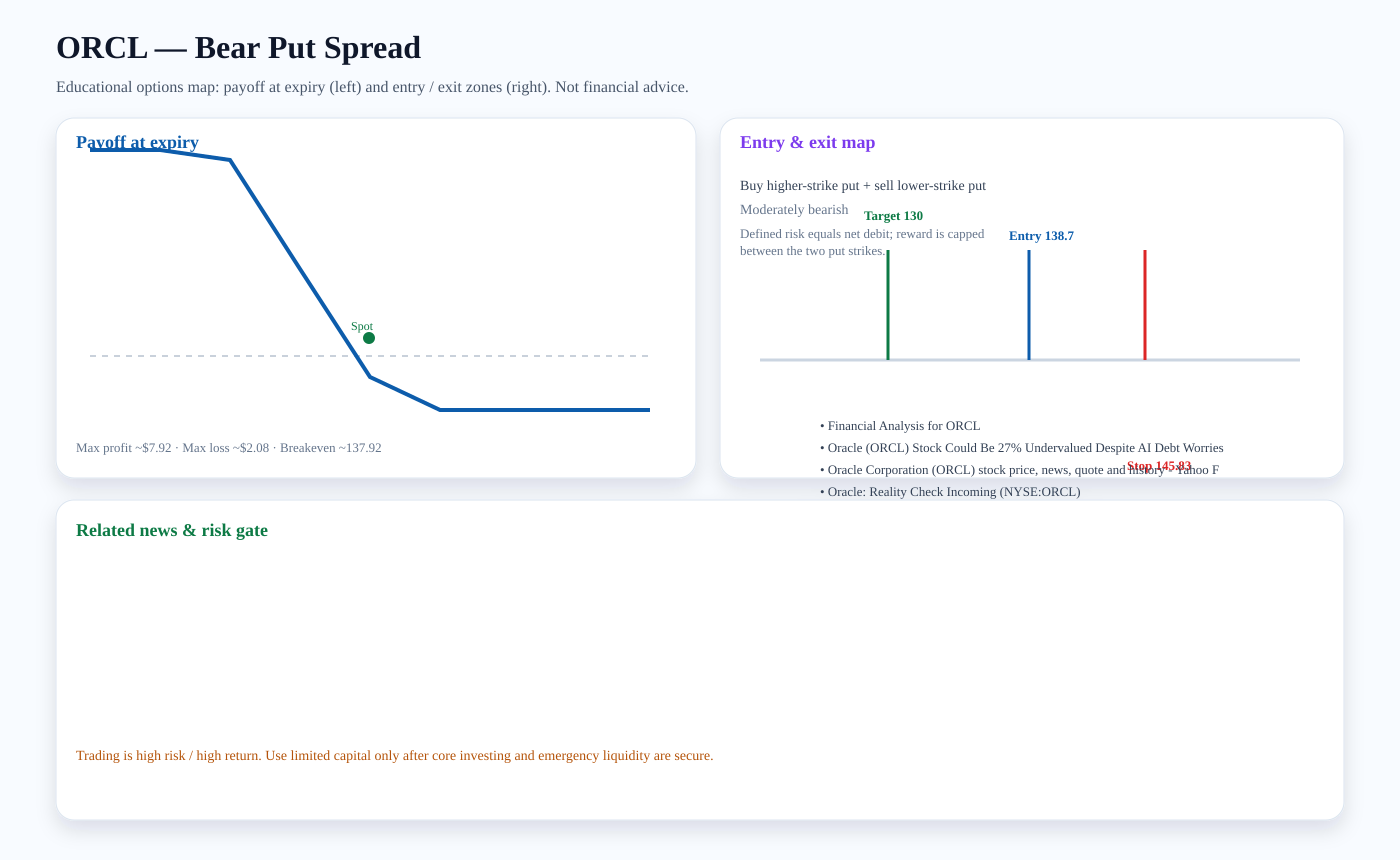
Structure: Buy higher-strike put + sell lower-strike put
Outlook: Moderately bearish
Entry zone: ~138.7 · Target: ~130 · Stop: ~145.83 · Breakeven: ~137.92
Risk note: Defined risk equals net debit; reward is capped between the two put strikes.
Related news links:
Payoff chart (Mermaid):
Entry / exit map (Mermaid):

MCD: Bear Put Spread
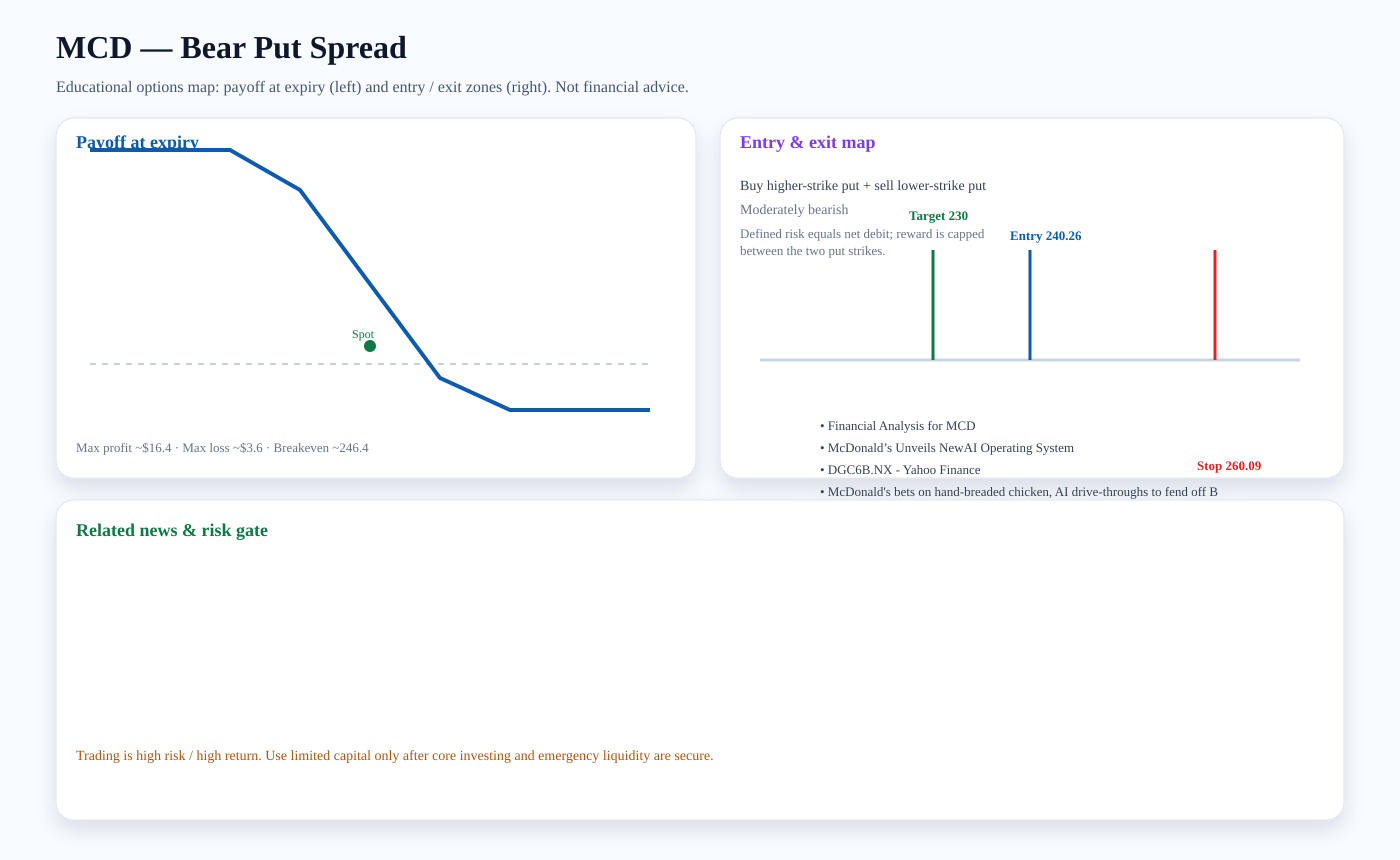
Structure: Buy higher-strike put + sell lower-strike put
Outlook: Moderately bearish
Entry zone: ~240.26 · Target: ~230 · Stop: ~260.09 · Breakeven: ~246.4
Risk note: Defined risk equals net debit; reward is capped between the two put strikes.
Related news links:
Payoff chart (Mermaid):
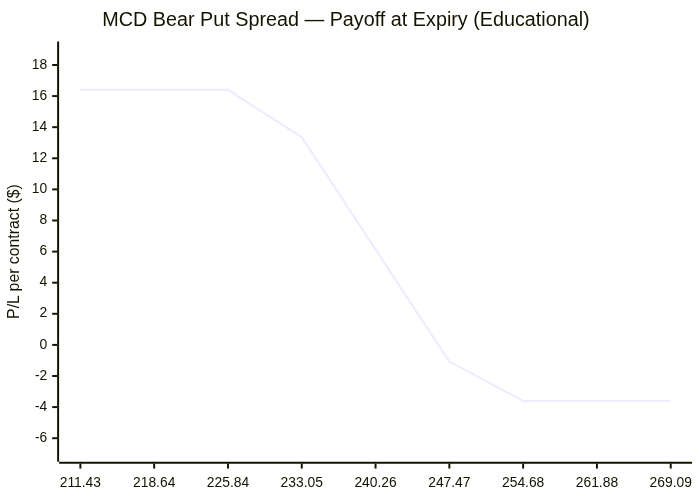
Entry / exit map (Mermaid):

U: Bear Put Spread
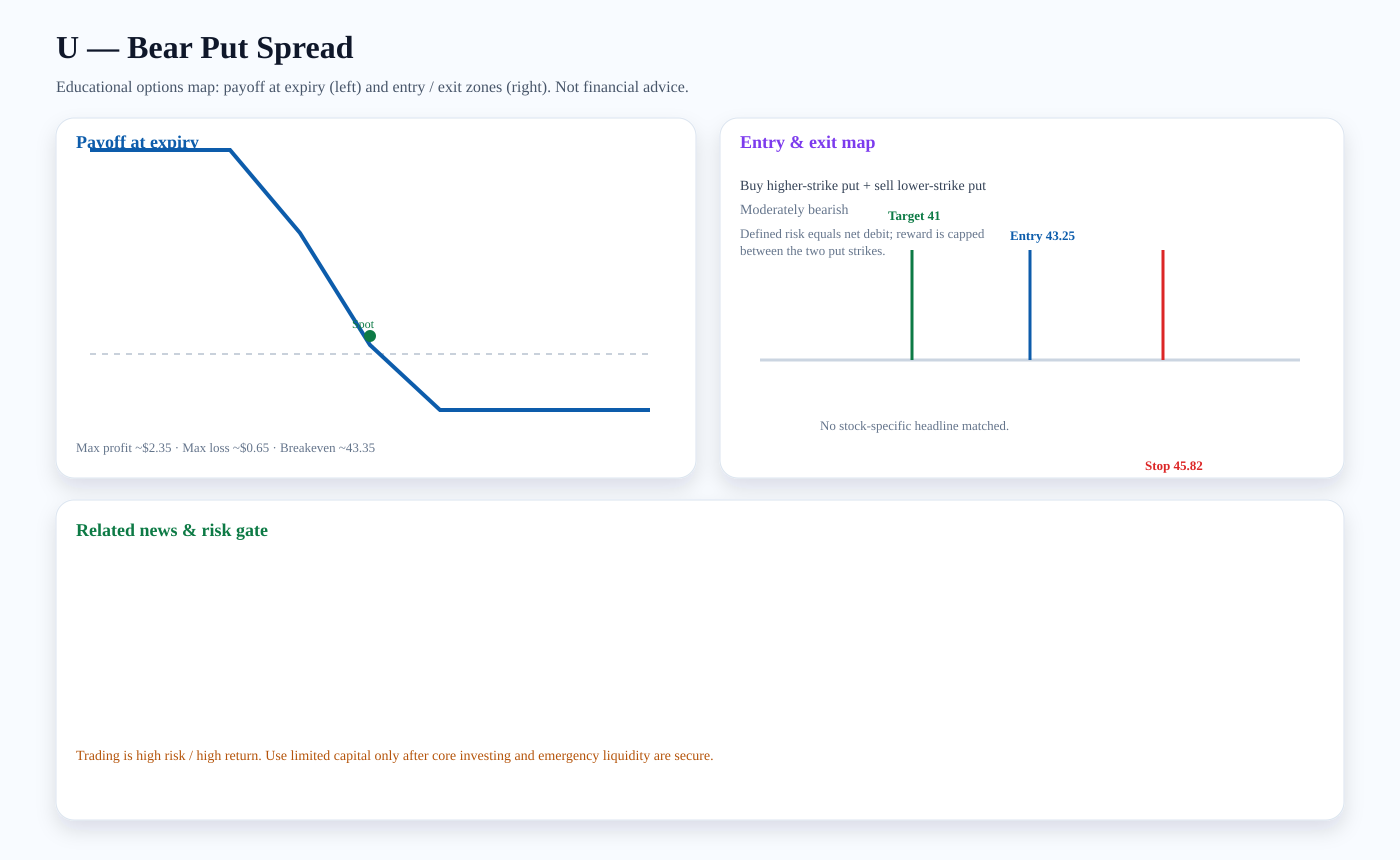
Structure: Buy higher-strike put + sell lower-strike put
Outlook: Moderately bearish
Entry zone: ~43.25 · Target: ~41 · Stop: ~45.82 · Breakeven: ~43.35
Risk note: Defined risk equals net debit; reward is capped between the two put strikes.
Payoff chart (Mermaid):
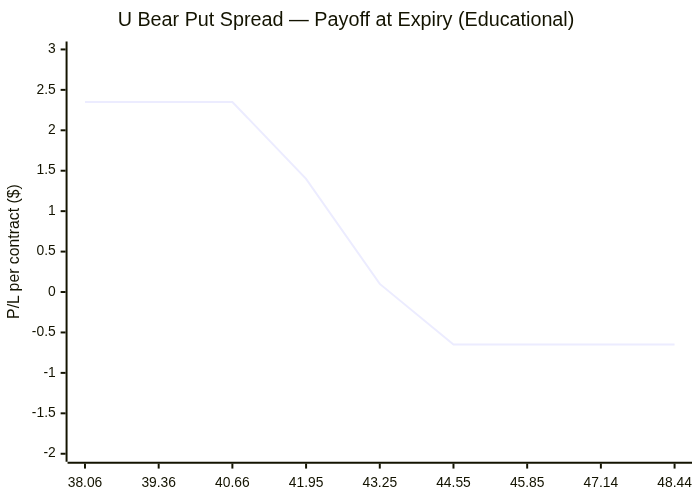
Entry / exit map (Mermaid):

Trading versus investing
Investing focuses on durable ownership, diversification, and compounding. Trading seeks faster tactical returns and carries higher risk. We treat options trading as limited-capital, educational analysis only after core investment capital and emergency liquidity are protected.
PDF report — Premium
Premium members get the full PDF attached to email briefs and can download it here. Upgrade for just $2 a month.
Subscribe for $2/month