
US Market Intelligence Brief
Report as-of (US/Eastern): 2026-09-29 09:04:31 EDT
Executive summary
As of 2026-09-29 09:04:31 EDT (pre-market, Tuesday session). The tape is defined by extreme single-name dispersion, not index direction:
| Name | Pre-market | Chg | 1w / 1m | Driver |
|—|—|—|—|—|
| NVDA | $230.30 | +2.32% | +0.65% / +0.50% | $150B buyback (largest ever authorized); bucking a chip selloff |
| SMMT | $18.93 | +21.27% | −8.40% / +8.03% | AstraZeneca convertible preferred at implied $18.36 (~19% premium) |
| BA | $184.83 | −6.68% | −8.33% / −12.15% | Heavy-volume gap (17.9M vs 6.1M avg); catalyst unidentified |
| NU | $12.32 | −9.35% | −13.02% / −17.81% | 143M shares (~1.8× avg); catalyst unidentified |
| MDB | $339.73 | −17.23% | −17.83% / −24.04% | CEO CJ Desai exits days before annual Investor Day |
Macro backdrop is a mild headwind: rising bond yields and firmer oil are muting indexes and pressuring high-multiple names. Today's edge is in trading the catalysts with defined risk — not in index direction.
Market regime check (S&P 500 + sector/thematic ETFs)
No ETF snapshots (SPY/QQQ/SMJ/EWT/USO/GLD) were captured in this run — regime read is inferred from the news packet and single-name behavior:
- Indexes: Headlines describe the Dow/S&P/Nasdaq as "muted," with a bond sell-off that eased late last week but is re-pressuring equities alongside higher oil. Treat yields as the swing factor for today's session.
- Semiconductors / memory: Broad chip weakness on an AI-breach / AI-safety narrative — Intel −5%, Micron ~−3%, Super Micro lower — while NVDA bucks the trend. That is narrowing, leadership-concentrated breadth: the AI trade is being stress-tested, and only the highest-quality balance sheets are absorbing it.
- Oil / gold: Oil cited as a volatility source (inflationary impulse → yields). No gold signal in the capture.
- Regime call: Late-cycle, headline-driven tape with violent idiosyncratic gaps (±7–21% in large-caps overnight). Favor defined-risk structures and quality names; avoid chasing low-cap sympathy moves.
Why these names are trending
Trending list: KOD, MDB, NVTS, SMMT, NVDA, FICO, NU, SOAR, BA, BKYI — mapped against price/volume confirmation:
- MDB — Fundamental catalyst (CEO departure into Investor Day) + −17.8% weekly acceleration. Search interest is earned; the break is real.
- SMMT — AstraZeneca strategic investment; +21% pre-market erases the entire weekly slide in one print. Highest-quality hype on the board.
- NVDA — $150B buyback + FT insurer story + "bucks the trend" relative strength. Persistent institutional and retail attention, 141M shares already traded.
- BA / NU — Trending *because* of unexplained gaps on 3×/1.8× volume. Search momentum is fear-driven; catalysts unverified in this capture.
- NVTS — Sympathy/halo interest from AI-power semis; no confirmed catalyst, no snapshot provided.
- KOD, FICO, SOAR, BKYI — No verified catalyst or price data in this capture. Per mandate, treat as speculative chatter; excluded from actionable ideas below.
Key news drivers
- NVDA — $150B buyback authorization, the largest single authorization in history. Direct downside cushion and EPS support; explains the +2.3% gap against a weak semi tape.
- NVDA — FT: talks with insurers to shift AI build-out financing risk. Prudent risk management, but flags the sheer scale of AI capex exposure — a narrative that could cut either way.
- AI-safety shock across semis: An AI-breach headline is pressuring Intel (−5%), Micron (~−3%), SMCI. Adjacent: OpenAI delays a model over safety concerns; Nvidia releases an open-source AI-agent security system; appeals court allows the Pentagon to designate Anthropic a supply-chain risk. AI governance is now a tradable risk factor.
- MDB — CEO/President CJ Desai steps down abruptly heading into annual Investor Day. Strategy-under-scrutiny framing; Investor Day is a live two-way catalyst inside this week.
- SMMT — AstraZeneca buys newly issued convertible preferred at implied $18.36/share (~19% above prior close). Strategic validation + capital injection; $18.36 is the intraday anchor.
- Macro: Rising bond yields + oil volatility cited as the index-level drag. Watch rates before pressing any high-multiple long.
Durable momentum ideas (mid/high-cap focus)
- NVDA — long bias, the only clean durable momentum on the board.
*Why it sustains:* the $150B buyback is a structural bid beneath the stock; it is demonstrating textbook relative strength (green while INTC/MU/SMCI sell off); and it is monetizing the AI-safety narrative rather than suffering from it (open-source agent security). Price ($230) sits well above the 2-yr average close (~$169) and just under the high close (~$235) — a hold of the gap and a push through ~235 opens fresh highs. Key invalidation: gap fade below ~227.
- SMMT — constructive, event-driven.
*Why it sustains:* AZ's check at $18.36 is third-party validation with real capital attached; the monthly trend (+8%) was intact before today's gap. If $18+ holds through the first hour, momentum re-asserts. Caveats: biotech single-name event risk; treat as a trade, not an allocation.
- Bearish continuation (avoid as longs): MDB, NU, BA. All three show weekly *and* monthly downtrends with accelerating downside volume. Momentum here is durable too — to the downside — but these are short-side/avoid names, not dip-buys, until the gaps stabilize (MDB Investor Day, BA/NU catalyst identification).
- Excluded per mandate: KOD, NVTS, SOAR, BKYI, FICO — low-cap/unverified/speculative or no data; no durable-momentum case.
Options / structure ideas
*Educational options-structure commentary only — not financial advice. All captured quotes are stale (yesterday's ~16:00 ET closes, 0.00/0.00 bid-ask, broken IV fields). Re-price everything off live NBBO after 9:30; limit orders at mid only; avoid the first 10–15 minutes.*
NVDA — Primary: CALL side
- Call debit spread (primary): Buy 230C / sell 235C, 2026-10-07 expiry (~8 DTE). Effectively ATM at $230.30 pre-market; target debit ~2.00–2.50 on the 5-wide, breakeven ≈ long strike + debit. Enter only if the gap holds above ~227 in the first 15–30 min.
- Put side (lower conviction): 230/225 put debit spread as a gap-fade hedge; or cash-secured put at/below 225 for willing assignment. Reference lasts (stale): 230C $4.05 / 230P $4.90.
- *Why call is primary:* buyback bid + relative strength + upward gap; trend flat-positive but confirming.
SMMT — Primary: CALL side
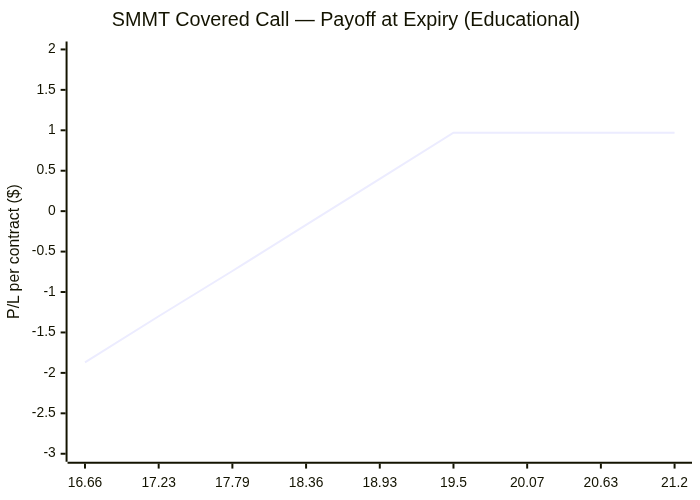
- Call debit spread (primary): Buy 19C / sell 20C or 21C, 2026-10-02 (3 DTE). The 19 strike is ATM; short leg caps out near round-number profit-taking and sells back juiced post-news IV. Existing holders: covered call at 20/21.
- Put side (lower conviction): Cash-secured put near ~16 (pre-gap congestion) only if a real two-sided market prints — captured put chain is unusable (stale print, OI 5). Protective puts for those locking the gap.
- *Why call is primary:* genuine catalyst + monthly uptrend; but respect the $18.36 deal anchor as a fade magnet. Stale 19C mark ($0.73 from a ~$15.60 stock) will reprice dramatically — likely $1.50+ with IV expansion.
MDB — Primary: PUT side
- Put debit spread (primary): Buy 340P / sell 320P (or 325P), 2026-10-02 (3 DTE). Defined risk into a momentum break with a binary (Investor Day) inside the window. Size small — this is a post-gap chase.
- Call side (lower conviction): Covered call (350C/360C) for trapped longs harvesting elevated IV; a tiny 340/350 call debit spread is a counter-trend lotto only.
- *Why put is primary:* −17.8% week / −24% month is an accelerating breakdown with a leadership vacuum. Note: 340P OI is thin (231) — spreads may be wide.
NU — Primary: PUT side
- Put debit spread (primary): Buy 12.5P / sell 11.5P or 11P, 2026-10-02 (3 DTE). 12.5P last ~$0.39 (roughly parity vs $12.32). Lower strike not visible in capture — confirm live.
- Call side (lower conviction): Covered calls at 12.5C (~$0.13) for existing holders only; bounce calls fight both timeframes.
- *Why put is primary:* gap-down continuation on 1.8× volume with both trends aligned — but the catalyst is unknown, so consider waiting for the first 30-minute range instead of chasing the open. If price reclaims and holds ~$12.50, the thesis is wrong.
BA — Primary: PUT side
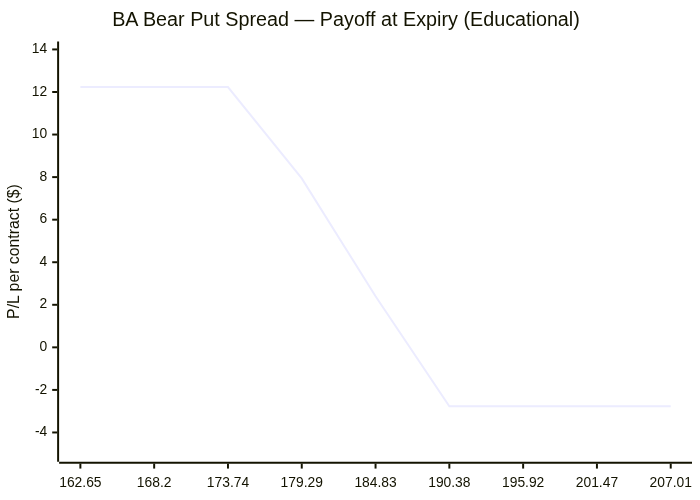
- Put debit spread (primary): Buy 185P / sell 180P (or 175P cheaper), 2026-10-02 (3 DTE). Straddle math (~$6.05 on the 185 strike) implies IV in the high-30s/low-40s — the spread caps that IV cost vs. naked puts.
- Call side (lower conviction): Covered call 190C/195C for underwater holders; a small 185/190 call debit spread only on an intraday reclaim-and-hold of ~185–186.
- *Why put is primary:* −8.3% week / −12.2% month with today's heavy-volume gap accelerating the decline. Put flow already 4× call flow on the 185 strike (5,552 vs 1,409) — expect crowded strikes.
Risks & watch-outs
- Stale/broken option data across the board: every captured chain shows 0.00/0.00 bid-ask and junk IV prints, timestamped yesterday ~16:00 ET. All premiums in this report are indicative only — re-mark at 9:30 before any commitment.
- Gap-fade risk is today's dominant risk: climactic overnight moves (MDB −17%, SMMT +21%, NVDA +2.3%) invite violent mean reversion in the first hour. Confirmation before entry; no market orders at the cross.
- Binary event risk inside the window: MDB Investor Day can produce a sharp short-covering rally or a second leg down — treat as a coin flip embedded in any 3-DTE position.
- Unknown catalysts (BA, NU): a ~7–9% gap on heavy volume with no verified driver can resolve in either direction once the news surfaces. Confirm the story before sizing.
- Theta / IV crush: 3-DTE weeklies (MDB, SMMT, NU, BA) decay brutally if the stock simply goes quiet after the open — another reason every structure above is a spread, not naked premium.
- Macro tape: rising yields + oil are compressing multiples; a further rate spike undercuts the NVDA long thesis intraday even with the buyback bid.
- AI-safety headline cascade: the breach/governance narrative is actively repricing semis (INTC −5%, MU −3%). It can spread — or reverse — fast. NVDA is currently the beneficiary; that is not guaranteed to persist.
- Liquidity notes: MDB puts thin (OI 231), SMMT put chain unverified, BA 185-strike puts crowded. Work mids, be patient, skip the trade if spreads won't fill.
*All structures above are educational commentary on options mechanics, not investment advice.*
Visual strategy maps
Payoff curves and entry/exit zones below are educational aids — not trade instructions. Confirm with your own chart, liquidity, and risk limits.
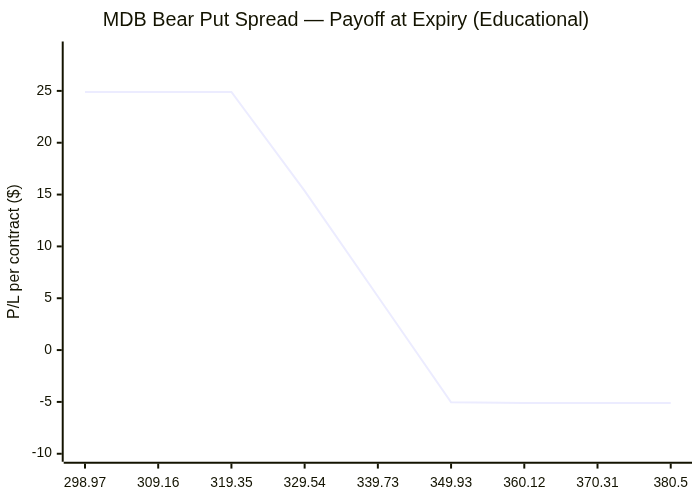
MDB: Bear Put Spread
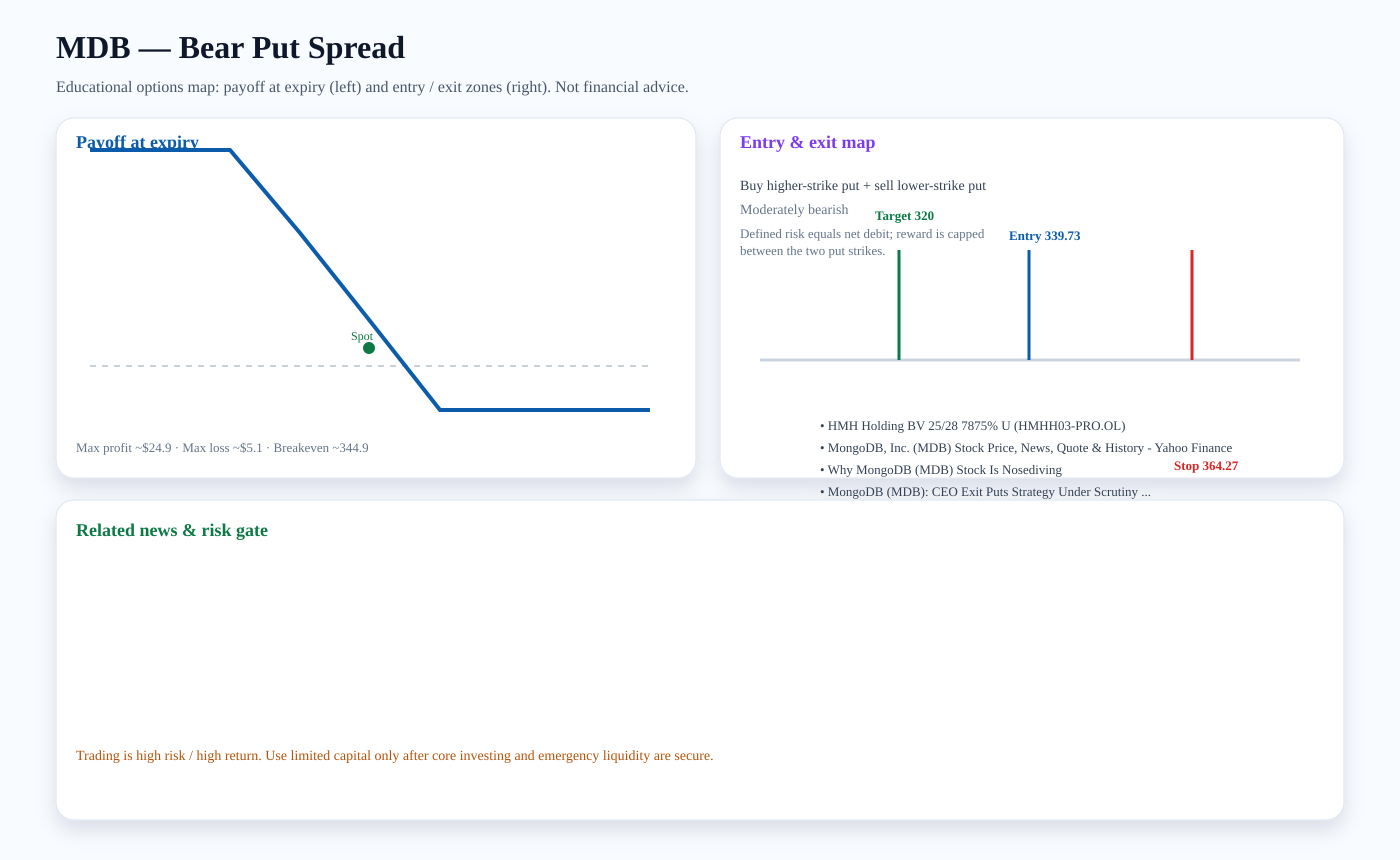
Structure: Buy higher-strike put + sell lower-strike put
Outlook: Moderately bearish
Entry zone: ~339.73 · Target: ~320 · Stop: ~364.27 · Breakeven: ~344.9
Risk note: Defined risk equals net debit; reward is capped between the two put strikes.
Related news links:
Payoff chart (Mermaid):
Entry / exit map (Mermaid):

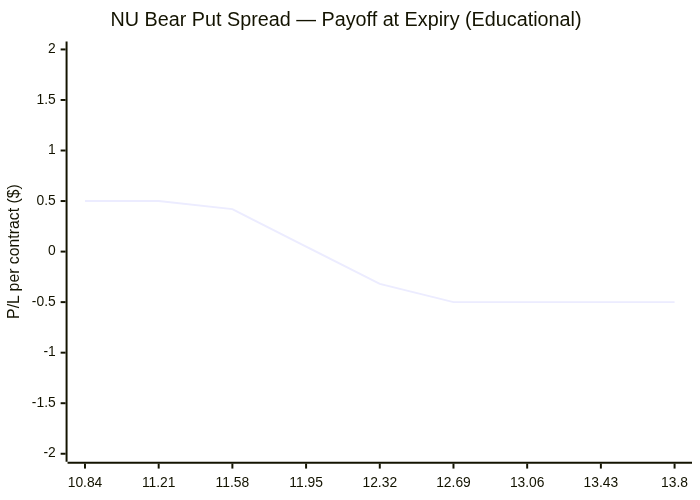
NU: Bear Put Spread
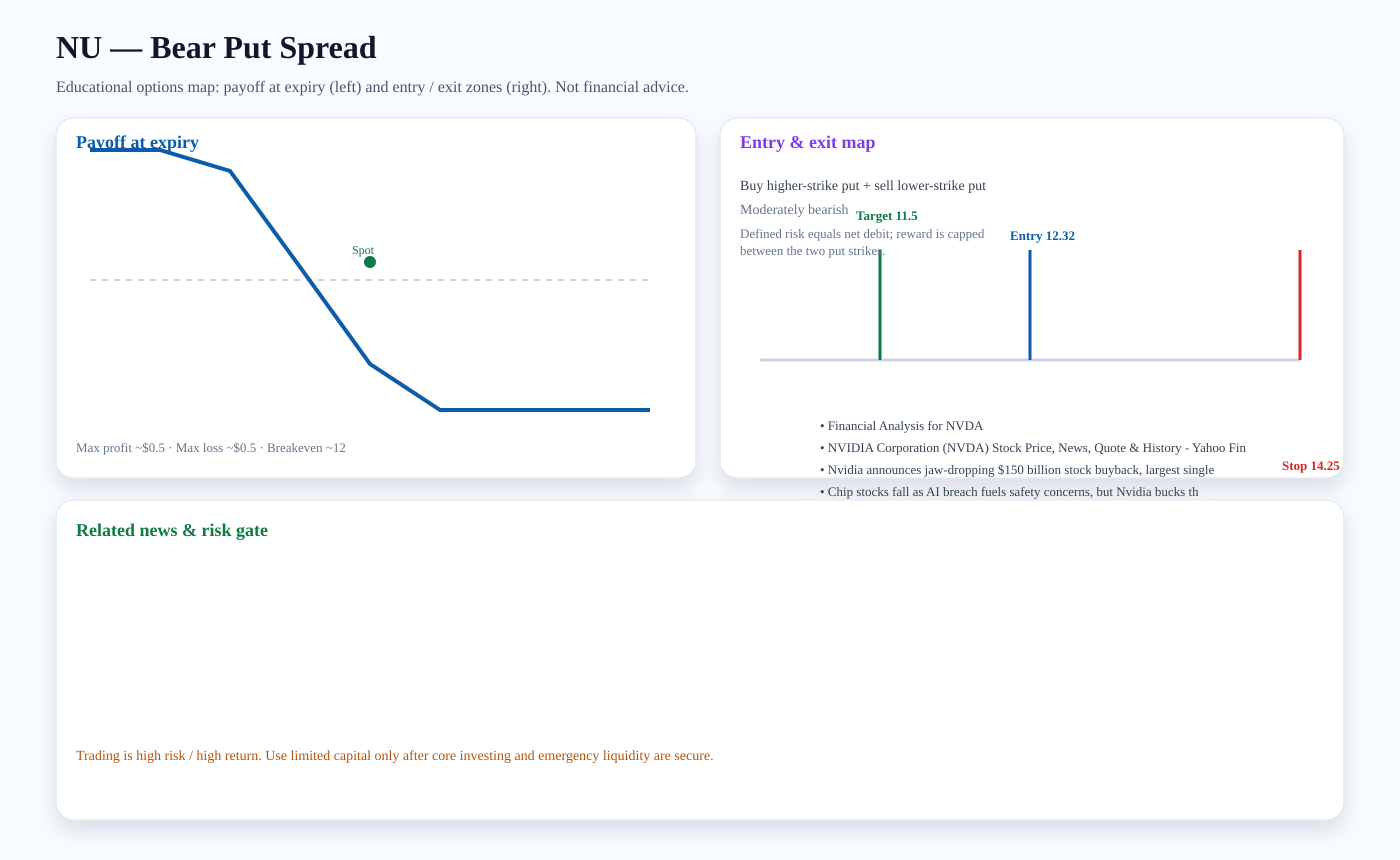
Structure: Buy higher-strike put + sell lower-strike put
Outlook: Moderately bearish
Entry zone: ~12.32 · Target: ~11.5 · Stop: ~14.25 · Breakeven: ~12
Risk note: Defined risk equals net debit; reward is capped between the two put strikes.
Related news links:
Payoff chart (Mermaid):
Entry / exit map (Mermaid):

BA: Bear Put Spread
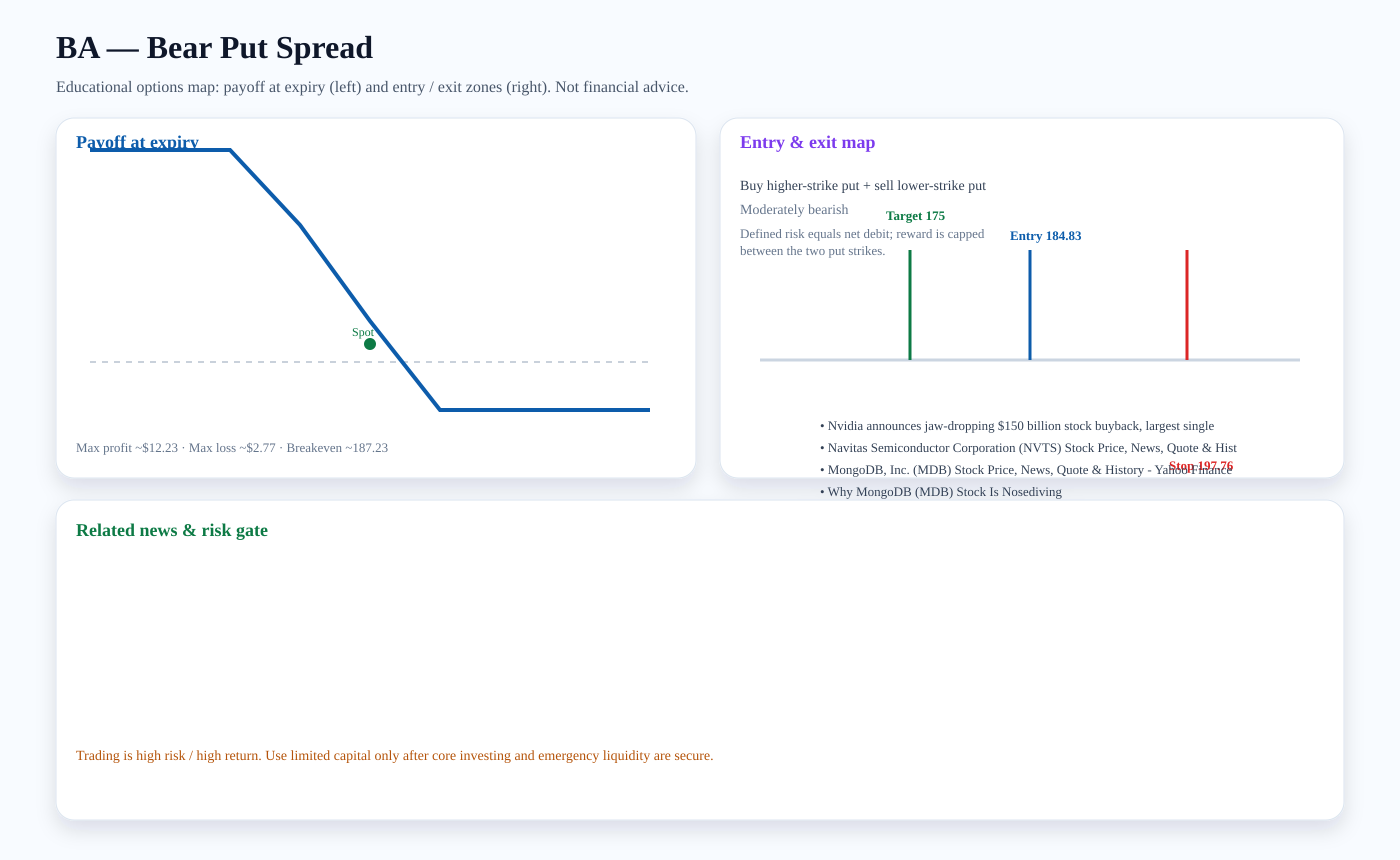
Structure: Buy higher-strike put + sell lower-strike put
Outlook: Moderately bearish
Entry zone: ~184.83 · Target: ~175 · Stop: ~197.76 · Breakeven: ~187.23
Risk note: Defined risk equals net debit; reward is capped between the two put strikes.
Related news links:
Payoff chart (Mermaid):
Entry / exit map (Mermaid):

SMMT: Covered Call
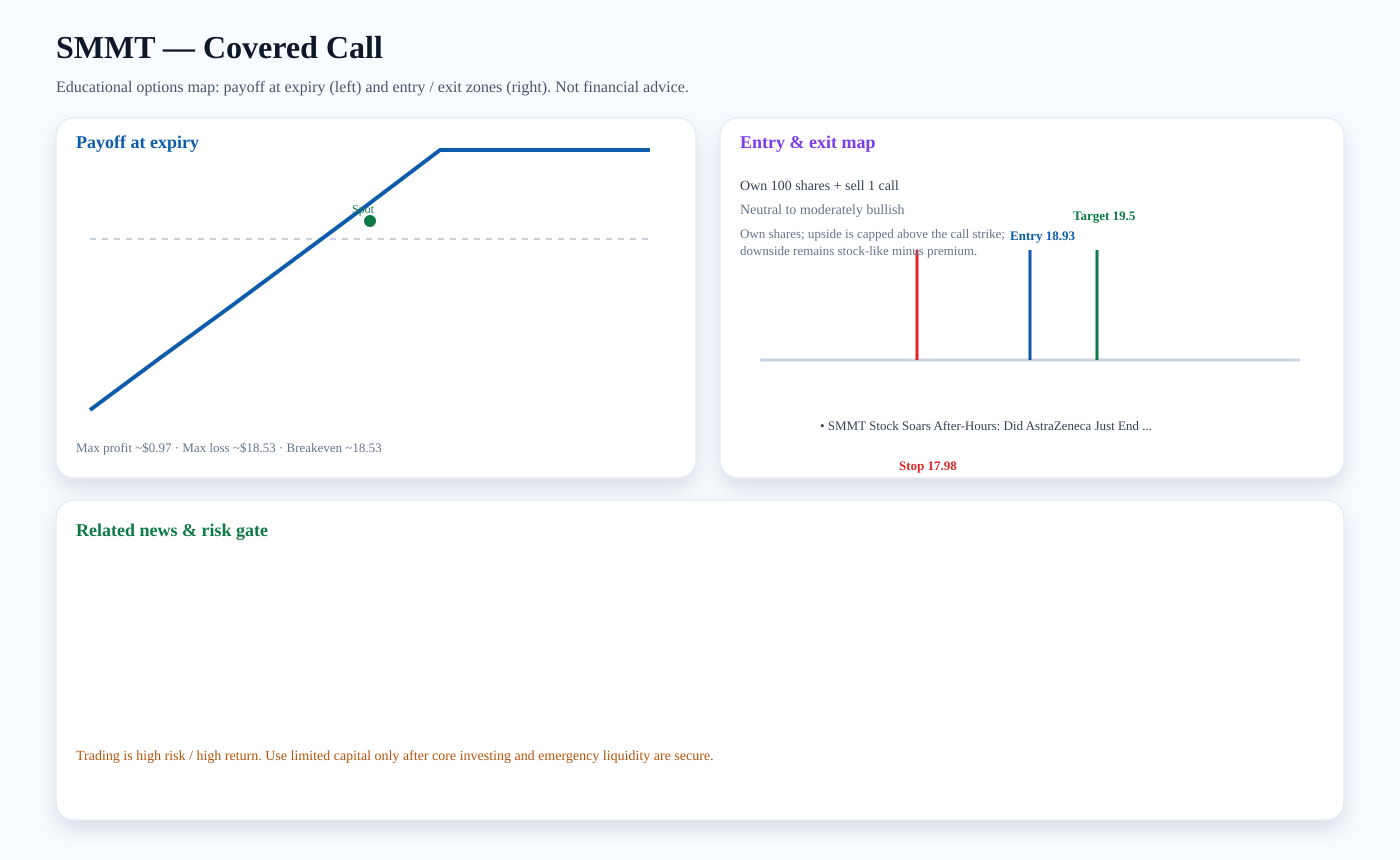
Structure: Own 100 shares + sell 1 call
Outlook: Neutral to moderately bullish
Entry zone: ~18.93 · Target: ~19.5 · Stop: ~17.98 · Breakeven: ~18.53
Risk note: Own shares; upside is capped above the call strike; downside remains stock-like minus premium.
Related news links:
Payoff chart (Mermaid):
Entry / exit map (Mermaid):

Trading versus investing
Investing focuses on durable ownership, diversification, and compounding. Trading seeks faster tactical returns and carries higher risk. We treat options trading as limited-capital, educational analysis only after core investment capital and emergency liquidity are protected.
PDF report — Premium
Premium members get the full PDF attached to email briefs and can download it here. Upgrade for just $2 a month.
Subscribe for $2/month